Best Practices for Safely Handling Glass
Guidance on glass inspection, lifting and carrying
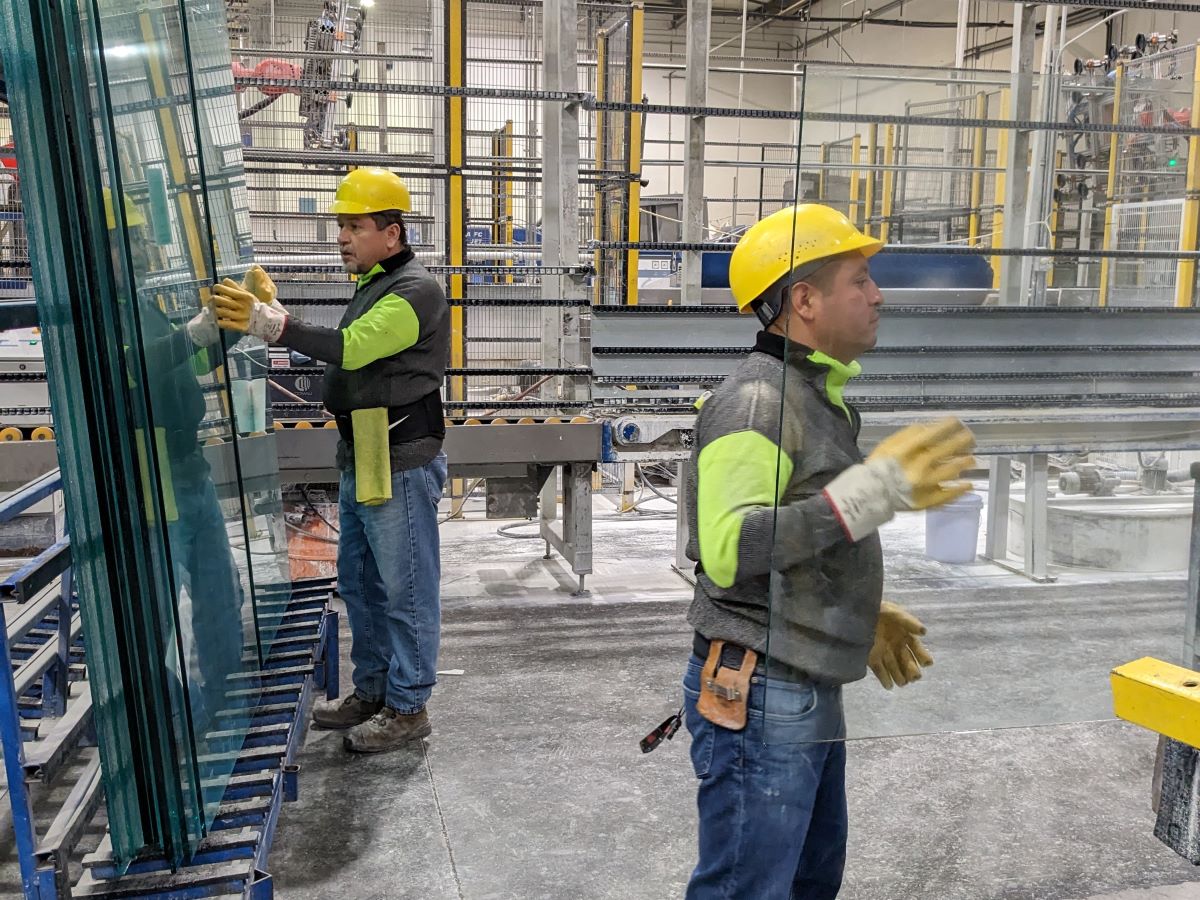
Courtesy of MyGlassFAB
When it comes to handling glass, following best practices is crucial to help keep production personnel protected throughout the glass fabrication process. From quality inspection, to lifting and carrying, personnel should be trained to handle glass lites safely.
MyGlassFAB offers online training on a variety of fabrication topics, including safe glass handling in the factory environment — available free to NGA members in good standing.
MyGlassFAB is NGA's dedicated online learning platform for glass fabricators — covering safe handling, factory operations, and more.
Inspect the glass
Before moving a glass lite, always check for blemishes or faults. Faulty glass can cause sudden failure while moving, which can result in injury for personnel, so it is essential to know the types of glass faults. If you find faulty glass, highlight the blemish—with a white pencil, for example—to warn others, and let your supervisor know so that the hazard can be dealt with safely.
Here are some of the different types of glass faults you need to be aware of before lifting glass:
- Score or cutting over-run. A score, or over-run, can occur during the cutting process. A score weakens glass lites and causes the glass to break when handled. The thinner the glass, the greater the risk of glass breaking.
- Cracks. Cracks in glass are often quite small and difficult to see and will result in an almost instant break or running of the crack, when handled. Cracks can also run longer on the lite than you realize, and some are only noticeable when light reflects off the crack at a certain angle.
- Seeds, bubbles or inclusions. During the glass manufacturing process, a seed, which looks like a very small bubble in the glass, or inclusion, which is created when a foreign solid or gas is trapped in the glass, can be created. These can cause the glass to lose its strength and durability, making it more susceptible to breaking. Large or small, they are an unacceptable quality fault that requires the glass be rejected. Always look for them when inspecting glass.
- Chips or shells: A chip or shell occurs on the edge of a glass lite. It’s a common blemish, as glass is often stored and moved on its edge. Always check glass edges for any chips or shells. If you find a chip or shell that you believe compromises the structural integrity of the glass, do not lift it.
Prepare for the lift
Before handling glass, protect yourself with the correct personal protective equipment. Appropriate PPE for plant personnel working with glass can include, but is not limited to:
- Hard hats
- Safety glasses
- Face shields
- Cut-resistant jackets with neck protection
- Aprons
- Closed-toe boots
Cut-resistant PPE. This is critical, particularly in the areas of the body where major arteries would render a cut most harmful. These areas include the neck, upper under arm, upper inside leg and wrist.
Stretch before lifting heavy loads. Stretching exercises include:
- Arm stretch: Extend your arms up overhead. Link the fingers with the palms turned upwards. Hold for 10 seconds; relax. Repeat 3 times. This stretches the arms, upper back, and shoulder muscles.
- Overhead arm pull: Raise your right arm, bending the right elbow, and touch your right hand at the back of the neck. Grab the right elbow with the left hand and pull to the left. Hold for 10 seconds; relax. Do the same stretch for the other arm. Repeat 3 times.
- Straight arm shoulder stretch: Hold your arm out, link your other arm under your elbow, and pull your straight arm towards you. Hold for 10 seconds; relax, then repeat for the other arm. Do this 3 times.
- Neck stretch: Tilt head sideways. Hold for 10 seconds. Recover; repeat for the other side. Perform 3 times.
- Back arch: Stand with your feet apart. Place your hands on your lower back to support it. Gently arch backwards and recover. Repeat 10 times to mobilize your spine. If you’ve had a lower back injury, check with your health provider that this stretch is okay for you.
One-person carry
There is no industry standard that lists the maximum weight for a one- or two-person carry. However, your company must have guidelines in place for you to follow that indicate the maximum glass size and thickness appropriate for a one- or two-person carry, as well as guidelines for using mechanical handling equipment. Even if the weight of a glass lite falls within company guidelines for a one-person carry, always ask for help if you are not comfortable carrying it on your own.
For a one-person carry:
- Always check that other people are out of your pathway and that the area is safe before lifting and carrying glass
- Always carry the glass vertically, never horizontally
- Never carry glass under your arm
- When handling small glass lites and walking a short distance, place hands on either side of the glass lite. Do not carry small glass lites with one hand.
- When handling larger glass lites, place one hand on the bottom edge, close to the center of the glass, with the palm up. The other hand can be placed either on the top edge or the side edge to control the balance. Always hold the glass so you can let go of it, and it can fall away from you.
- Carry the glass close to your body. You can use your shoulder to support and balance the glass.