Synchronizing the Factory Floor Supports Manufacturer Growth
Smart automation helps manufacturers tackle labor shortages, deliver more reliably, and strengthen customer relationships
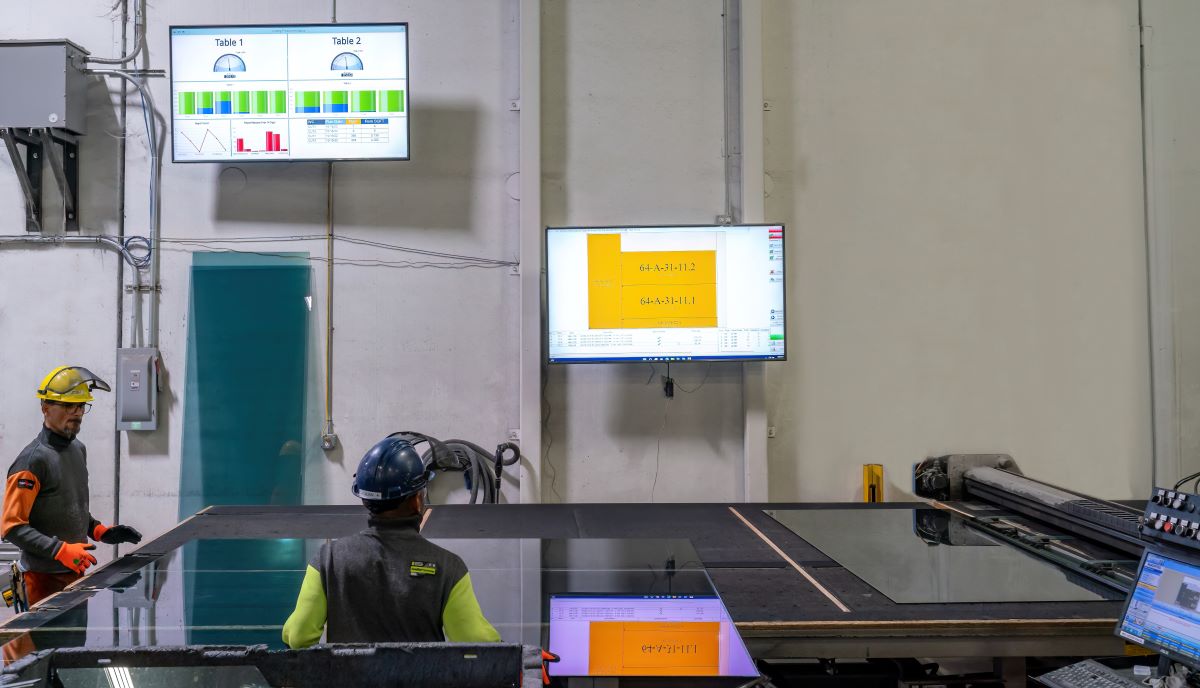
Above: Employees on the factory floor. Photo courtesy of Cyncly.
Labor shortages and increasing delivery expectations are structural challenges that will continue to place pressure on fenestration manufacturers. For window and door producers, the question is not whether to automate, but how to do so in a way that closes workforce gaps, improves delivery reliability and supports long-term growth.
The instinctive response for some manufacturers is to add automation wherever the pain is most acute in their production process. Yet deploying machines in isolation often introduces more complexity than it removes. Each disconnected system requires its own oversight, creates its own fragile handoffs, and generates data that doesn’t reach where it is needed most.
Fully automated, “lights-off” production is not a realistic starting point for most manufacturers, and it does not need to be. Most fenestration manufacturers begin by connecting what they already have: linking existing machines, aligning workflows, and building production visibility without a wholesale infrastructure overhaul. These steps deliver immediate value while laying the groundwork for what comes next.
Synchronize the shop floor for predictability
Efficiency at the machine level does not guarantee efficiency across the plant. In fact, local optimization can make plant-wide flow worse by accelerating output in one area while creating congestion in another. A faster cutting line means little if downstream assembly becomes the new bottleneck.
Synchronizing automation with plant-wide flow changes this dynamic. When capacity is balanced across work centers and production sequences are coordinated rather than optimized in isolation, WIP buildup falls, finished goods congestion eases, and on-time delivery becomes something you can plan for rather than chase after.
This is where automation’s impact on labor and delivery converge. A synchronized shop floor requires fewer manual interventions to stay on track, reducing dependence on experienced operators to identify and resolve imbalances in real time. At the same time, it produces the predictability that sales and operations teams need to make confident delivery commitments.
Consider how Architectural Window Manufacturing, a custom commercial window producer in New Jersey, tackled a familiar problem: a growing catalogue of profiles and paint hooks that made it increasingly difficult to keep their paint line running efficiently. The complexity fell on operators to manage manually. Using software, they centralized all relevant extrusion data in a single, reportable format—a targeted fix implemented in less than a day. The result was a 30% increase in paint line efficiency, and the line no longer depended on experienced staff to keep it moving. They solved the bottleneck not with a larger workforce or a new machine, but with better information, flowing to the right place at the right time.
The impact of connected operations on delivery performance is measurable. Vinylmax, an Ohio-based window and door manufacturer, found that integrating operations across every stage, from order entry through to shipping, gave them the visibility and process consistency needed to make and keep reliable delivery commitments. The result was a four-day production turnaround and a 99% on-time delivery rate. For their customers, that kind of reliability formed the basis of a stronger relationship.
In a market where a missed window or a delayed door order can cost a dealer relationship, that predictability has direct commercial value. Manufacturers who can consistently tell contractors and dealers when product will arrive, and then deliver on that commitment, build a competitive advantage that is difficult to replicate.
Turning data into real-time decisions
Real-time data from connected machines provides visibility into actual capacity, downtime, and production status. Teams can schedule based on what is actually happening on the floor, not what was planned weeks ago. When a line slows or goes down, that information surfaces immediately rather than as a missed shipment days later. Bottlenecks can be resolved before they affect downstream operations.
When production is synchronized, data is accurate, and workflows reflect actual capacity, companies can confidently commit to delivery dates. This credibility is critical in a market where delays can quickly damage customer relationships.
The goal is not to automate tasks, but rather to build systems that make an operation smarter, delivery more reliable, and customer relationships stronger. In an environment defined by labor constraints and rising expectations, that is the foundation for competing—and winning—in the next era of fenestration manufacturing.