
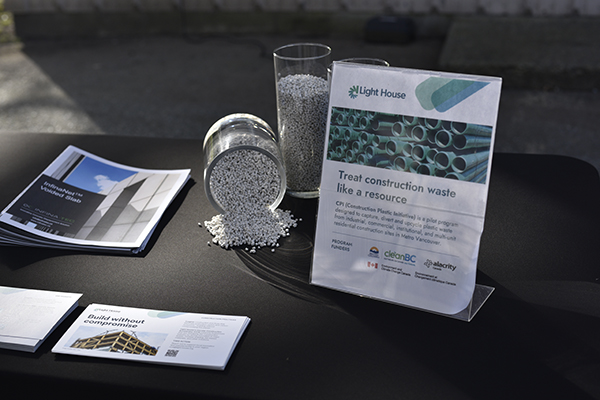
Light House, an organization focused on advancing regenerative and circular practices in the built environment, has released results from the Construction Plastics Initiative (CPI), a 14-month pilot that tracked plastics across eight active construction sites in Metro Vancouver and successfully demonstrated how these materials can be recovered and reintegrated into new building materials under real-world conditions.
Program overview
Launched by Light House in 2024, CPI was created to address a gap in how plastic waste is understood and managed in construction, renovation, and demolition (CRD) activities. While most attention has focused on consumer packaging and single-use plastics, construction-related plastics have remained largely overlooked. Through the pilot, materials from eight commercial construction sites were collected, tracked, sorted, processed, and reintegrated into manufacturing, demonstrating how construction plastics can be recovered and reused in new building materials.
Delivered in partnership with contractors including Aecon, EllisDon, and Scott Construction, the study followed plastics across major projects including the Holdom Overpass Project in Burnaby, PNE Amphitheatre, Steveston Community Centre and Library, Cloverly School, Amazon and Microsoft tenant improvement projects, and Lynn Fripps Elementary School. Together, these projects provided a real-world dataset and one of the clearest pictures to date of how construction plastics are generated, handled, and what can be recovered in practice.
Pilot findings
Across participating sites, more than 83,700 pounds of plastic were collected. Of the 75,000 pounds sent for sorting, approximately 77% was successfully classified for recycling. The strongest results were observed in clean, packaging-related materials such as films and wraps. Approximately 23% could not be processed due to contamination, handling conditions, or system limitations, despite being technically recyclable, showing that much of what is lost today is recoverable with the right systems in place.
Plastics generated during construction are often dominated by packaging materials. These materials are typically clean, consistent, and produced in high volumes, making them among the most readily recoverable plastics on construction sites. The findings show that a significant share of construction plastics, particularly packaging-related materials, can be recovered under the right conditions.