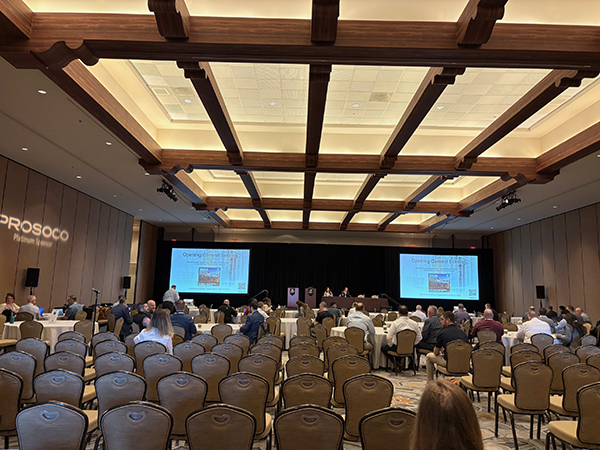
At the Fenestration and Glazing Industry Alliance Annual Conference, fire safety and cyber safety were topics explored amongst attendees and speakers, among other topics prevalent to the glass and fenestration industries. The annual conference was held in Huntington Beach, California, March 2-5.
Keynote addresses cybersecurity
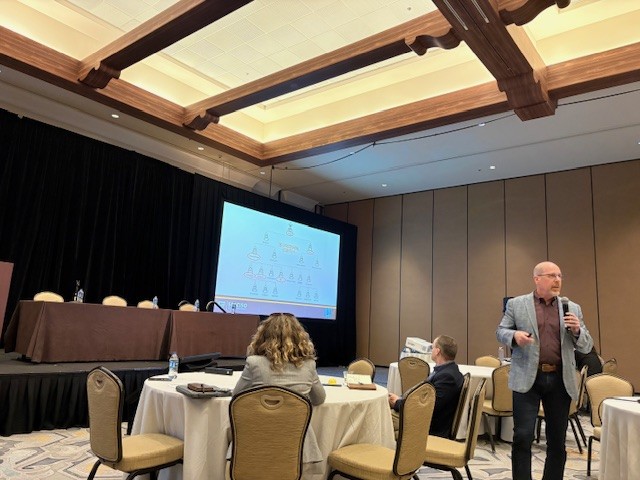
The keynote address, given by Chief Safety Information Officer Brian Scott, focused on cybercrime and how employees can keep themselves and their companies safe from this new wave of criminals. Scott discussed the evolving landscape of cybercrime, emphasizing the importance of understanding its drivers and the new role of AI.
Scott says that AI is driving the professionalism behind cybercrime. With the use of AI, there has been an increase in fake videos and fake audio. Scott says in the next two to three years, this type of cybercrime is going to be a "whirlwind."
Cybercriminals are also using AI to craft phishing emails with correct grammar and no spelling mistakes, so it's harder to identify as phishing. AI is also used to take information from LinkedIn and other social media accounts to personalize the phishing emails to an individual.
Scott says that if cybercrime were measured as a country, it would be the third largest economy in the world, behind China and the U.S. Business email compromise accounted for $2.77 billion in losses and tech support scams accounted for $1.46 billion in losses in 2025.
According to Scott, the “path of least resistance” is the golden rule in cybercrime. It is usually "low hanging fruit," like someone clicking on a link or not changing their passwords. Simple mistakes are how much of cybercrime is still happening.
So, what can employees do to protect themselves? Scott emphasized the importance of multi-factor authentication, a password management system and training the workforce using things like simulated phishing attacks.
Fire Safety
A research team from UL Research Institute's Fire Safety Research Institute, consisting of Gavin Horn, Daniel Gorham, and Joseph Willi, discussed how window materials perform under fire exposure.
The UL team conducted structure-to-structure fire spread experiments on a variety of different window pane assemblies, single-material window frames and multiple-material window frames (like fiberglass exterior and wood interior) to see how different assemblies performed under fire exposure.
Key takeaways:
- Window pane assemblies with annealed glass on exterior and tempered glass on the interior outperformed windows with the opposite configuration.
- Vinyl and wood frames were most susceptible to failure.
- Aluminum frames were top performers, but still vulnerable to failure due to secondary components.
- When it comes to window protection methods, foil-faced fiberglass is the most effective, followed by fiber cement board and intumescent wrap.
- There are inexpensive and practical ways to protect windows, which will always be better than an unprotected window.
The UL team suggested visiting firesafemarin.org for tips on window fire safety.
Later on in the conference, this team got back together for a town hall style session where attendees could make their voices heard about what they would like to see them research next and ask questions about their research. Some ideas included researching fire exposure to commercial-specific windows, looking into the glazing of the IGU to the frame, window coverings to the exterior (like shutters) and how glass thickness would impact fire safety.
Innovation and automation
A panel at the conference focused on practical strategies for driving change in manufacturing. “Innovation in Factories and Offices – Enhancing our Workforce with Automation and Core Product Simplification” was moderated by Ray Garries of Miter Brands and the panel included Dr. Kamran Abedini, chair and professor in the Department of Industrial & Manufacturing Engineering at California State Polytechnic University, and Founder of FlexScreen and Joe Altieri.
Abedini emphasized the importance of innovative design principles and a user-centric design. He used the analogy of solving a jigsaw puzzle to illustrate the need for a clear end goal. Abedini says a common misconception is that innovative designs are hard to manufacture, which is not true as long as fewer parts are needed and there is cross-functional innovation, meaning multiple teams are working together.
"Innovation in products doesn’t fail in design, it fails at scale, cost and consistency," says Abedini. "Design for manufacturability is designing products that are easy to make, assemble, install and maintain. Do not cut corners, make things cheaper or let the factory 'kill the design.'”
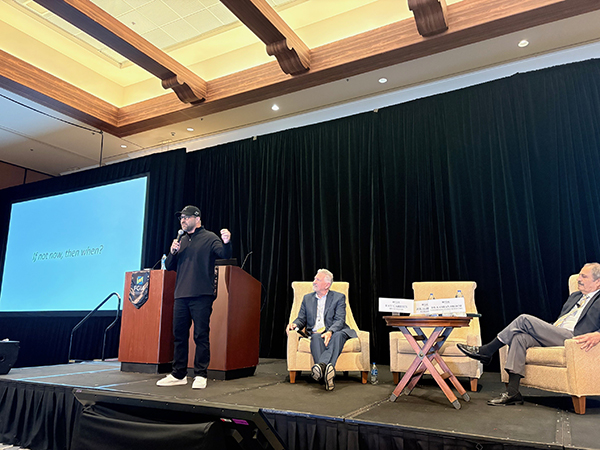
Altieri discussed his experience creating FlexScreen from the ground up, starting in his garage at home and making it all the way to the television show Shark Tank. Specifically, Altieri stressed to the crowd the importance of automation and not waiting to jump in. "If not now, when?" was a quote repeated throughout his presentation.
FlexScreen started working with Erdman Automation to see if there was a way to automate the manufacturing of the product. It was going to cost $6 million to create three machines, a cost that Altieri says was difficult to justify to investors so early on in the company.
“You can polish inefficiency for years and still be trapped inside of it,” says Altieri. "Optimizing an old system is not the same as redesigning it. Do we defend the familiar, or redesign for what’s next?"
Four licensees agreed to buy the machinery before the first one was even made, so FlexScreen never even had to pay for the second or third.
"The timing mattered more than the machinery itself," says Altieri. "Tech and automation advance at the speed of leadership. Laggers wait until there’s no other choice left. Once the pressure is obvious, the terms have already changed. An issue with some people is you want profession from the start. Give in to the process. It doesn’t have to be perfect or how it will go to market from the get-go."