Anatomy of Windows in Wildland Urban Interface Zones
How lessons from testing and forensic investigation can lead to products and configurations better suited to survive a conflagration
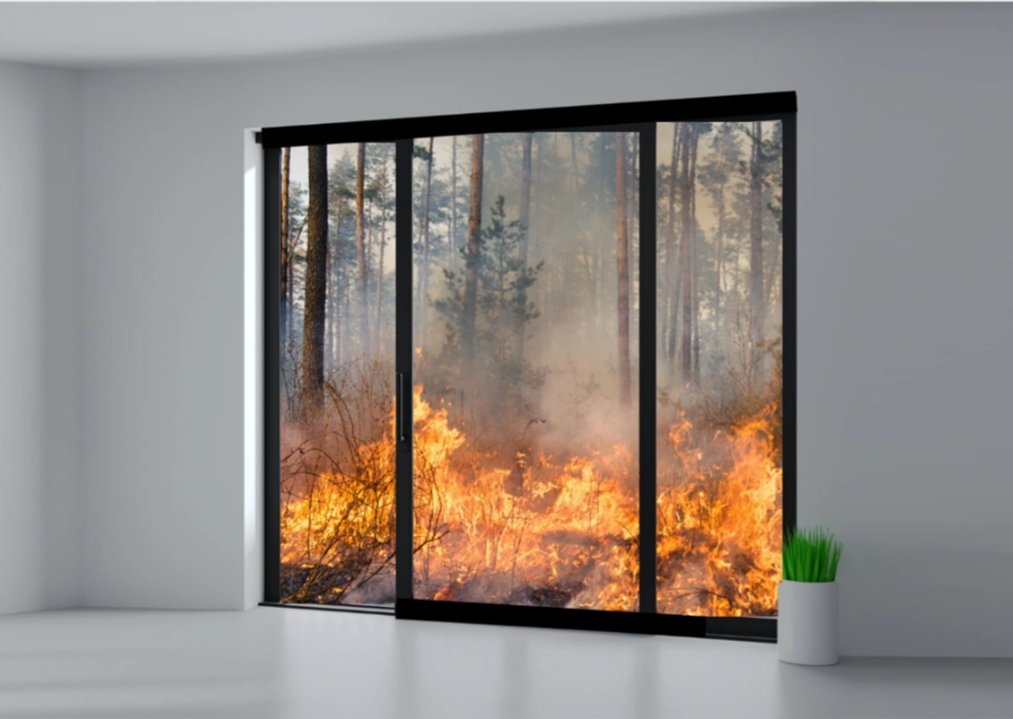
Catastrophic conflagrations have damaged or destroyed thousands of homes over the past four decades. New developments often abut wildland with topography and vegetation that are vulnerable to rapidly developing fires. Climate change with extended periods of drought, extreme weather events and high winds exacerbate this. Attempts to mitigate damage by hardening structures in Wildland Urban Interface (WUI) zones have led to limited testing and development of building codes intent on increasing a structure’s likelihood of surviving a fire storm. The challenge for windows is staying intact long enough to prevent flame penetration to the inside of the structure.
Under section 505.8 of the International Wildland-Urban Interface Code (IWUIC) exterior windows, window walls and glazed doors, windows within exterior doors, and skylights shall be tempered glass, multilayered glazed panels, glass block or have a fire protection rating of not less than 20 minutes.
In California’s 2025 Wildland-Urban Interface Code section 504.8 Exterior Glazing, exterior windows, window walls and glazed doors, windows within exterior doors, and skylights shall be constructed of any of the following:
- Multilayered glazed panels with at least one pane of tempered glass complying with Section 2406 of the California Building Code
- Glass block
- Glazing with a fire-protection rating of not less than 20 minutes when tested according to NFPA 257 or UL 9, and shall be exempt from the hose stream test
- Glazing meeting the performance requirements of SFM Standard 12-7A-2
While current WUI codes allow conventional readily available windows and doors through meeting prescriptive requirements, IGUs that include tempered glazing, the performance path is much more daunting. Testing under NFPA 257 or UL 9 require an exposure duration of 20 minutes, while California’s SFM Standard 12-7A-2 requires exposure for 8 minutes. Very few residential window manufacturers have certified products that meet either of these performance-based criteria.
As a key component in residential development, windows allow views, light, and fresh air in while keeping the elements at bay. In addition to these attributes, window design and construction have fostered many advancements in energy efficiency, security and impact resistance. Based on the scale of destruction due to fire in recent years, windows are a focus in hardening of structures that border WUI areas. These efforts are expanding to include the built environment, or residences that are deeper into a neighborhood where structure to structure fire spread is being considered.
The challenges facing the window industry include understanding the duration and intensity a product’s design and construction are expected to resist, while maintaining a cost structure and aesthetic that is acceptable to the market. Design and materials used must consider failures that allow any flame impingement from outside to inside, which could include breakage and evacuation of glazing, gaps in weatherstripping, gaps created by frame deformation, failures in hardware, etc.
Glass considerations
WUI codes for windows and doors tend to focus on glass. This makes sense, as glazing is the largest component based on surface area and breakage and evacuation results in open paths for fire to the inside of a structure.
The assumption that insulating glass units will be used for thermal efficiency is a given. When choosing glass for potential use in windows in wildland urban interface zones the following should be considered as staying intact and retention are key to preventing fire intrusion. Resistance to thermal stress fractures, and break patterns contribute to the overall integrity of a fire exposed window.
Annealed glass is most commonly used in residential applications where safety glazing is not required. Annealed glass has a relatively low threshold for exposure to thermal stresses. Annealed glass typically breaks due to thermal stress when experiencing a temperature differential of roughly 30∘C to 50∘C (86∘F to 122∘F) across the pane, depending on edge quality. The break pattern typically emanates from the glass edge, not near a corner, and meanders toward the center, resulting in large shards of glass.
Heat-strengthened glass is commonly used in commercial applications where opaque spandrel panels are used between floors or where inconsistent shading creates shadowing across a portion of the lite. These conditions create high temperature gradients within the lite, which increase thermal stresses. Just as with fully tempered glass, heat strengthened glass is seamed, which involves sanding the edges and eliminating most edge damage.
Heat-strengthened glass can withstand a temperature differential of 100∘C (212∘F). Heat-strengthened glass breaks into large, sharp, angular shards similar to annealed glass. Unlike fully tempered glass, which shatters into small, diced particles, the larger fragments of heat-strengthened glass tend to remain in the window frame, providing better containment after breakage.
Fully tempered glass is commonly used when increased strength and safety are required. Fully tempered glass can withstand non-uniform temperature gradients of approximately 200∘C to 250∘C (392∘F to 482∘F). When tensile stress exceeds the limits of fully tempered glass, breakage is explosive and results in a break pattern consisting of many small pieces.
While not yet commercially available in large sizes typical in residential window construction, chemically strengthened glass is a high-performance, ion-exchanged material, typically six to eight times stronger than annealed glass. It features exceptional surface compression, high scratch resistance, and superior optical clarity without distortion or roller marks. Chemical strengthening also significantly enhances the resistance to thermal stress fracture, and the break pattern is similar to annealed or heat-strengthened glass. As thin triple IGUs become more readily available, a chemically strengthened inner lite of thin glass could have implications for windows in wildland urban interface zones.
Early testing showed that the makeup of an IGU has an impact on the duration a window can remain intact enough to keep flames from breaching the envelope. As expected, annealed glass is most vulnerable to radiant heat and direct flame exposure. This testing illustrated annealed glass fractured due to thermal stress within a few seconds of exposure. Based on the break pattern and redundancy of multiple panes of glass in an IGU, windows with annealed glass failed within a few minutes of exposure.
Windows that included fully tempered IGU showed improvements in the time of fracture due to thermal stress, but the break pattern allowed the glass to evacuate the opening shortly after the initial stress fractures. As WUI building codes embraced lessons from early testing, hybrid units including at least one lite of fully tempered glass were specified.
More recent testing by UL Fire Safety Research Institute shows that the position of the tempered glass lite has an impact on the duration of exposure before failure. IGUs with an outboard lite of annealed glass and fully tempered lite inboard, outperformed units with the opposite configuration. This makes sense intuitively as the break pattern of annealed glass allows large pieces of glass to remain in the opening vs. tempered glass that falls out shortly after breaking.
In very recent testing, glass thickness appears to have a dramatic impact on pane integrity, a lite of glass that is fractured but maintains enough integrity to stay in place as a solid plain that acts as a barrier to flame impingement. While a very small sample size, inclusion of 3/16-inch glass points toward validation the impact thicker glass can have when exposed to extreme fire conditions. Two windows were tested that included IGUs consisting of 3/16-inch tempered/tempered in the upper sash and 3/16-inch annealed/tempered in the lower sash. Both windows maintained “pane integrity”—thermal stress fractured glass that maintained continuity long enough to pass the 8-minute mark with no direct flames to the interior of the window.
The use of heat strengthened glass in one or both lites of an IGU has yet to be tested but may offer an additional measure of protection, based on higher resistance to thermal stress fractures and the large shard break pattern.
The spacer and sealants used in assembly of the IGU is important when fire exposure is considered. The primary seal needs to be consistent with best practices for moisture barrier and gas retention. A non-combustible secondary seal is recommended to isolate the primary seal and add structural integrity to the IGU.
The method of glazing needs to be considered as retention of the IGU is key to enhanced performance when exposed to fire. For IGUs set in the frame and sash relying on adhesion, non-combustible liquid sealants (wet glazing) should be considered, as foam glazing tapes can lose adhesion when exposed to heat. Mechanical means of securing the IGU should also be considered, as retention in the opening is key to blocking flame impingement. For dry set and gasket glazing, the materials used should be non-combustible. Recent UL Fire Research Institute testing observed ignition of boot gaskets.
Weatherstripping, hardware and framing
While glass and glazing are key to building a window in wildland urban interface zones, weatherstripping, hardware and framing play a significant role. Fire resistant or non-combustible weatherstrip is recommended as it is often the barrier to flame impingement at interlocks and around operable sash components. Locking and balancing hardware need to remain in place and functional throughout the exposure duration, as failure can result in sash movement that open gaps that could allow flame impingement.
Although all windows failed at some point during the recent UL testing, some framing materials faired better than others. While steel framing has been utilized in fire-rated windows, it was not included in the recent UL research testing. Testing focused on aluminum clad wood, aluminum, vinyl, and fiberglass window framing. All windows tested were double hung configuration. Ultimately all frame types failed but the mode of failure varied.
Other than impingement due to IGU failure, sash sagging due to frame deformation or hardware failure occurred in all window types. Double-hung windows rely on locking and sash balances to keep the sashes in place. Care should be taken to include sash balance retention that is not susceptible to deformation or release when exposed to high heat. The same caution should be taken with locks and keepers. To enhance the performance of vinyl framed windows exposed to fire, additional attention should be paid to reinforcing hollows within the perimeter and sash to support the IGU, anchor hardware, and minimize frame deformation.
In summary, as building code development catches up with demand for more windows in wildland urban interface zones, using what we have learned through testing and forensic investigations can lead the fenestration industry to products better suited to survive a conflagration. Glass, glazing, weatherstrip, hardware and reinforcements can combine to build products that are more likely to survive high intensity, short duration fire exposures. This approach should have positive results as we look to participate in well-designed future testing.